
One Habit to Rule them All
- Connor Bubear
- Jul 30
- 5 min read

"Above all, do not lose your desire to walk. Every day I walk myself into a state of well-being and walk away from every illness. I have walked myself into my best thoughts, and I know of no thought so burdensome that one cannot walk away from it."
— Søren Kierkegaard

Kierkegaard wrote those words in the nineteenth century. He had no access to randomised controlled trials, wearable technology or nutritional epidemiology. None of that fancy stuff. Yet what he acquired from lived experience, is now one of the most consistently supported findings in modern health science.
Walking is not a consolation prize for people who cannot run. It is not a gentle warm-up for a real workout. It is one of the most complete, versatile and underrated health interventions available to midlifers, and most people are doing far less of it than they think, and far less than they need.
Unlike a midlife crisis, midlife drift does not announce itself. It accumulates slowly and quietly, one sedentary hour at a time. The commute by car, the desk job, the sofa in the evening. The average adult in the developed world now sits for nine to ten hours a day, and the physiological consequences of that stillness are not offset by a single gym session. The enemy is not ageing. The enemy is staying still.
The good news is that the antidote is free, requires no equipment, carries virtually no injury risk, and can be done almost anywhere. It touches every pillar of the SHIELD protocol. And it starts the moment you stand up.

What Walking Does to Your Body
Muscle tissue is the body's primary site of glucose disposal, and walking activates it continuously, drawing blood sugar out of circulation and improving insulin sensitivity with every step. Research published in Diabetes Care found that three ten-minute walks taken after meals reduced post-meal blood glucose spikes more effectively than a single thirty-minute walk taken at another point in the day. For midlifers navigating the early stages of insulin resistance or metabolic sluggishness, meal timing and movement must work together.
Walking also burns fat as its primary fuel source. At low to moderate intensity, the body preferentially oxidises fat rather than carbohydrate, making it one of the most sustainable and joint-friendly fat loss tools available. Unlike high-intensity exercise, it does not trigger the compensatory hunger response that often undermines caloric deficit.
For those already walking consistently, rucking, walking with a weighted rucksack, multiplies the stimulus significantly without adding injury risk. The Lord of the Rings fans among you will know that Samwise Gamgee carried a pack laden with pots, pans, rope and provisions all the way to Mordor and back, and, while Tolkien may not have had posterior chain development in mind, the principle holds. Rucking builds posterior chain strength, elevates heart rate and increases caloric expenditure by thirty to forty percent compared to unloaded walking. Just add weight and keep moving.
What Walking Does to Your Brain
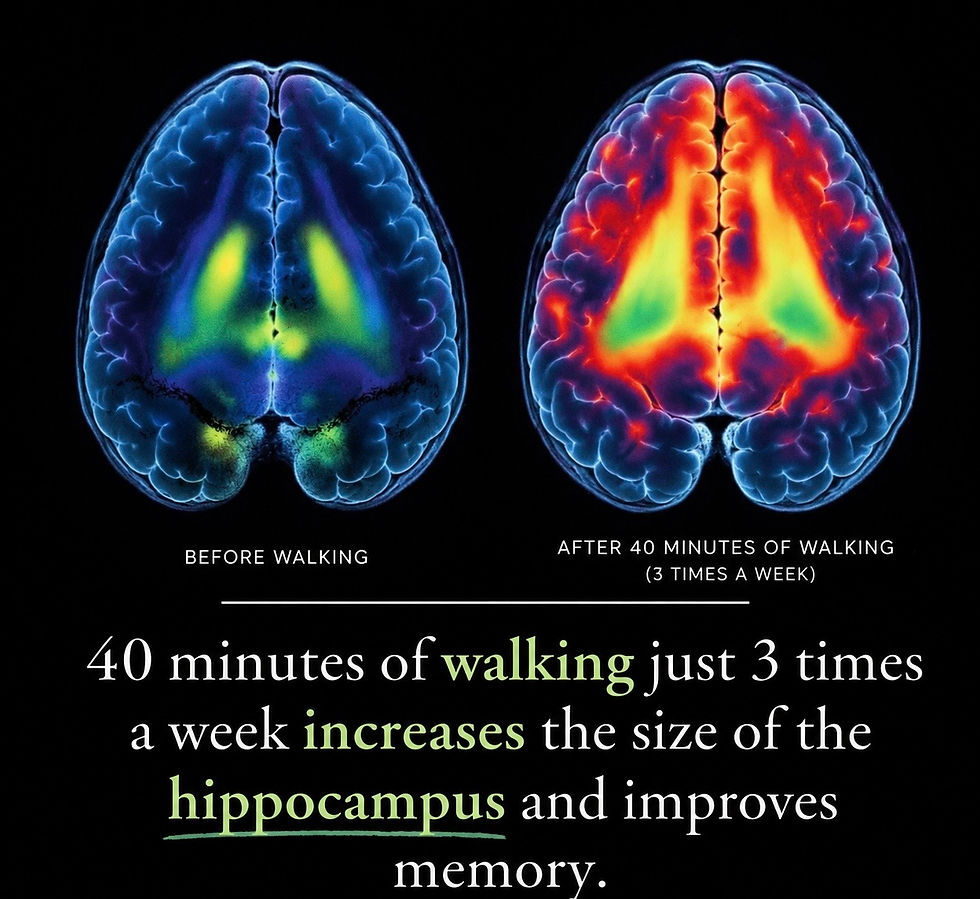
Walking increases the production of BDNF, brain-derived neurotrophic factor, the protein that supports neurone growth, maintenance and repair. It improves blood flow to the prefrontal cortex, the region governing executive function, decision-making and emotional regulation. Research published in the Proceedings of the National Academy of Sciences found that adults who walked regularly showed significantly less age-related shrinkage in the hippocampus, the brain's primary memory structure, than sedentary peers.
Walking also processes stress in a way that sitting cannot. The bilateral, rhythmic nature of walking activates both hemispheres of the brain alternately, a mechanism that mirrors the bilateral stimulation used in EMDR therapy for emotional processing.
This is why problems that feel insurmountable at a desk often resolve themselves on a walk.

When You Walk Matters
Timing your walk is one of the simplest ways to multiply its benefit without adding a single step.
A morning walk in natural light is one of the most powerful circadian anchors available. Early light exposure triggers a cortisol peak at the right time of day, which in turn advances melatonin onset in the evening, making it easier to fall and stay asleep. People who get outdoor morning light consistently fall asleep faster and sleep more deeply than those who do not. It also kickstarts digestion and metabolism, setting the body's internal clock for the hours ahead.
On top of that, a walk after meals, particularly after lunch or dinner, is one of the most effective metabolic interventions available. As the Diabetes Care research shows, even ten minutes of post-meal walking meaningfully blunts the glucose spike that follows eating. This is particularly valuable for midlifers whose insulin sensitivity is already declining. Movement and digestion are not separate events, so doing them together amplifies both.
Lastly, an evening walk supports the wind-down of the stress response and signals to the body that the day is ending. It is one of the most underused tools for improving sleep onset and reducing the cortisol carry-over that keeps so many midlifers wired at bedtime.

What Walking Does for Your Soul
The Japanese practice of Shinrin-yoku, or forest bathing, involves walking slowly and attentively through natural environments. Research published in Environmental Health and Preventive Medicine has documented measurable reductions in cortisol, blood pressure and sympathetic nervous system activity following time spent among trees. Phytoncides, the airborne compounds released by trees, have been shown to boost natural killer cell activity for up to seven days after a single forest walk.
Any outdoor walking in natural light, away from screens and the demands of your inbox, provides psychological restoration that indoor environments simply can’t match.
When done with another person, it becomes one of the most natural social connection practices available. Side by side conversation tends to be more emotionally open than face to face interaction, and Blue Zone populations walk as a communal daily habit. For those whose schedule makes outdoor walking difficult, a walking pad delivers the metabolic and circulatory benefits that sedentary time does not (some movement is always better than none).
The Midlife Opportunity
Most people know they should walk more. What stops them isn’t a lack of knowledge, but rather a lack of intention.
As we covered earlier, midlife drift is not caused by dramatic failures. It’s caused by the accumulation of small defeats. You take the lift instead of the stairs, the car instead of the ten-minute walk, and sit on the sofa instead of taking an evening stroll. Together, over months and years, these inconspicuous things compound into the fatigue, the weight gain, the brain fog and the disconnection that midlifers mistake for inevitable ageing.
But, the goods news is that none of these things are inevitable. They are reversible. To get started, you do not need a programme, or a health tracker. Just walk after your next meal. Walk in the morning before the day takes over. Walk with someone you have been meaning to catch up with. The research is indisputable.

Long Story Short
Walking is not a consolation exercise. It is one of the most complete health practices available. Here is where to start:
Walk in the morning: outdoor light anchors your circadian rhythm, sets your cortisol curve and improves sleep onset that evening
Walk after meals: ten minutes blunts blood glucose spikes and supports digestion and insulin sensitivity
Walk in the evening: softer light and rhythmic movement wind down the stress response and improve sleep onset
Walk to discharge stress: a twenty-minute walk after work is a physiological intervention, not just a pleasant habit
Walk in nature whenever you can: the cognitive and immune benefits of Shinrin-yoku are measurable and significant
Walk with someone: side by side movement is one of the most natural social connection practices available
Ruck if you want more: add a weighted rucksack to multiply the metabolic and strength stimulus with no additional time
Walk away from the drift: every step is an act of intention against the quiet accumulation of midlife inactivity
The real enemy is staying still, and the olution is completely free. So start using it!


Comments